Posts

Showing posts with the label kampung ayer

Ristaan Rumah-Rumah Lama Kampong Ayer

Image
Rumah yang dipercayai berpuaka – tempat Tentera Gurkha menjaga keselamatan penduduk kampung di sekitar Kampong Ayer – pada tahun 1962. ’Jambatan Fail’ kayu pada tahun 1970, iaitu sempadan antara Kampung Sungai Kedayan dan Kampung Ujong Tanjung. Sekumpulan kanak-kanak yang tinggal di Kampong Ayer pada tahun 1960, kelihatan berada di pantaran. Kampung Sungai Kebun pada tahun 1959. Ristaan rumah-rumah lama Kampong Ayer September 9, 2017 Oleh Haji Mohd Daud Abdul Rahman BANYAK sejarah dan kisah-kisah lama yang masih segar dalam ingatan penulis sewaktu zaman kanak-kanak menetap di Kampong Ayer. Kanak-kanak pada ketika itu gemar berenang bersama rakan-rakan mereka terutama ketika air pasang. Keadaan sungai di Kampong Ayer pada zaman itu juga kelihatan begitu bersih dan bebas dari pencemaran. Kampung Sungai Kebun pada tahun 1959, keadaan air sungainya juga begitu menenangkan dan keindahan suasana kampung dikelilingi dengan rumah-rumah jenis ‘Rumah Beidong’ pada zama...

Brunei's Heritage, Nature and History from the Water

Image
Azli Azney BANDAR SERI BEGAWAN Sunday, April 3, 2016 GENTLY making its way down the Brunei River, the MV Sentosa gave its passengers a whole different view of the familiar landmarks of the capital city. It’s a familiar view for water taxi operators and those living in Kg Ayer (water village). But, for most Bruneians, the scenic ride gives a refreshed vista and experience. Now, there are several ways to enjoy the river cruise. One way is by getting on the water taxis that are available at the different jetties along the Brunei River, most popular of which are the jetties in front of the Yayasan Shopping Complex. The other is by taking the MV Sentosa, which I did recently, down the river while luxuriating on typical amenities such as cushioned seats and air-conditioning. Not that I have anything against riding the speedboats used by the typical water taxi operators; I love the feeling of wind in my face as we zip speedily down the ri...

Kunyit 7 Lodge - Homestay on Kampong Ayer

Image
Azli Azney BANDAR SERI BEGAWAN Sunday, August 30, 2015 IT WAS a desire to share her beloved childhood and heritage that drove Dk Kemariah Pg Hj Duraman to open up her grandfather’s house and convert it into a cosy bed and breakfast for locals and tourists alike. Hearing about it from a friend, I decided to pay Kunyit 7 Lodge a visit by making a short boat trip to the house, less than one minute from the Yayasan jetty in Bandar, where I met the gregarious owner of the lodge, who is also known as Kem for short. The house, located right behind the No 2 jetty of Kampung Bakut Berumput at Kampong Ayer, has a mixture of classical Bruneian architecture – there since the 1920s and was last rebuilt in 1988 – and modern with the recycled wooden furniture, the decking and the French doors. Named after her late grandfather, Pg Tujoh, which means seven in English, and the fact that he loves the spice Kunyit, or turmeric, the lodge is both a homage to her late grandfa...

Kampong Ayer Past and Present

Image
Kampong Ayer in the 1950s. Source (Rozan Yunos Collection) Kampong Ayer - Past and Present RozanYunos Bandar Seri Begawan Sunday, December 6, 2015 IF YOU are a Kampong Ayer aficionado or a former resident, the destruction of all the old houses by the Brunei River bank, will surely bring back memories. Over the years, many villages in Kampong Ayer have disappeared and many familiar villages names remain only in memories. These names include Sultan Lama, Khatib Sulaiman, Ujong Pemukat, Bakut China, Menjalin, Sungai Panga, Bakut Berumput, Sungai Kuyuk, Kuala Peminyak, Pandai Amas, Sungai Siamas, Sumbiling, Sumbiling Baru, Sungai Kedayan, Ujung Tanjung, Pemancha Lama and Bukit Salat. If we want to compare the changes with what Brunei used to have in Brunei’s Water Village of the past, the one book which must be read is the book written by Sir Spenser Buckingham St John entitled “Life in the Forests of the Far East” first published in 1862 in two volumes by Smith, Elder and...

The Tale of the Unfilial Son

Image
[Note: An edited version of this article was published in The Golden Legacy column in Brunei's national newspaper, The Brunei Times dated 31st March 2007.] There was this tale of a local boy, who went away to better his and his family’s lot in life. After many years, he achieved success and wealth, married a a noblewoman and became the owner of a huge ship, forgetting his humble roots in the process. One day, in order to take shelter from an impending storm, his ship happened to berth near his birthplace. His ageing poverty stricken mother recognising him rowed out in a canoe calling out to her long lost son. In front of his beautiful rich wife, he was too ashamed to acknowledge her as his mother and threw her overboard. She was shocked and very depressed and placed a curse on her unfilial son whereupon a storm suddenly appeared capsizing the ship and transforming it into rock. Another variation to the story was that he was well to do but went away just the same, to find out what t...

Circumcision in Old Brunei

Image
In Brunei and in Indonesia, circumcision is known as bersunat but in Malaysia, berkhatan. In the earlier days, bersunat is considered as the mark of a true Muslim. Immediately just before the circumcision, the boy would be asked to recite the ‘kalimah sahadat’ which is the recitation every Muslims or would be Muslims undertake to declare themselves as Muslims – thus by saying it just before the circumcision, made him a true Muslim. Bersunat or circumcision is the procedure that removes the foreskin of the boy's organ. The word circumcision comes from two Latin words which mean to 'cut around'. A variation to this 'cut around' was practiced in one Brunei community more than 50 years ago. During the ceremony the ‘penyunat’ (the circumcision master) would go to the base of the organ and snip a little nerve. The nerve connects to the foreskin and the foreskin as a result would ‘pull back’ – thus ‘circumcising’ the boy. You still reached the objective of not having the ...

Brunei in the 2nd World War

Image
I didn't realise there was a lot of interest in the WWII photographs I posted recently. I have a number of articles about the war and the invasion of Brunei. The one I found interesting was in the Time Magazine issue of June 25th, 1945, where an article entitled "Walkover on Borneo" described how the Allied Forces liberated the island of Borneo from the Japanese. The most interesting bit is the one that described Brunei Town. You can read the original at this link . The article is reproduced below (with the italics mine): --- "Quote" --- Two hundred warships of the U.S. Seventh Fleet stood in to Brunei Bay in northwest Borneo. Off went the landing craft, with less than a division of hardbitten, hard-swearing Australian veterans. One week later, with spectacular ease, they had conquered a major harbor, three airfields, three towns, two islands and a peninsula. With minor losses, they had given General Douglas MacArthur a military base midway between Manila and S...

Memukun - Brunei's Unique Tradition

Image
I was staring at the computer last night raking my brain for today's topic when I heard someone being interviewed about 'memukun' on Rangkaian Nasional. Rangkaian Nasional has a program where people can actually sing through their telephones - a duet with another singer in the studio. I remembered in the 1980s when 'memukun' first appeared on national radio. A number of people who were trading at the tamu recorded the nightly programs and played their casettes at top volume. You could not escape from it if you are there. Anyway, I thought the interview is worthwhile reproducing here. One of the unique feature of Brunei's culture is 'memukun'. It is fairly hard to describe unless one has actually listened to it. I read on BB that it has been described as 'quatrain singing to the tune of traditional hand drums' . Memukun is very Bruneian where a group of people (usually elderly) will sing accompanied by gulingtangan or a small drum and sometimes ac...

Padians of Brunei's Kampung Ayer

Image
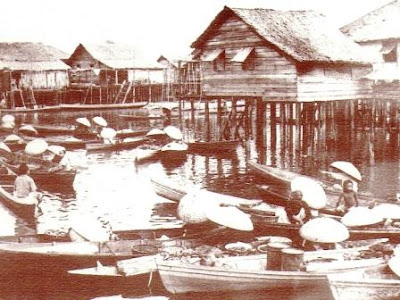
I was having a chat with my mother the other day talking about our visit to the floating market in Thailand when my father was in the diplomatic service. My mother told me that the floating market is strictly more for the tourists coming to Thailand. She said that usually by about 11 when all the tourists have left, the floating market traders would disappear too. There was hardly any local which actually buy the food from them. So I was thinking why not recreate the padians? Padians, if you are new to this blogsite, have often been mentioned here. They are generally women traders with large hats who used to ply among the houses in the Kampung Ayer but have completely disappeared now. To create a tourism thing, we should hire a few people who will go round plying their wares around the houses. The object is not so much about selling those wares but about them being visible and being tourist attractions. The history of padians from what I have read so far goes as far back as at least 60...

Tales of a Village

Image
Imagine about a hundred years back when 'padians' were still selling wares among the houses in the water village. Among the goods and wares that the padians would be selling would be food and fruits. With Bruneians living on the water, someone somewhere would have to plant the food and fruits and someone would have to get them from somewhere. This was the job of 'pengalu' and not 'padians'. Pengalus function more like wholesalers and are generally men unlike the padians who are generally women. Pengalus are the ones who would be going deep into the interior of Brunei to get food supplies and other foodstuffs in exchange for goods which came from the Kampung Ayer such as the metal and brasswares and also goods which came via ships coming from abroad. Pengalus would bring the goods to trade with the Bruneians who lived further inland and exchanged them with fruits and other food stuffs. The rivers were the main and only transportation networks in those days. There...

Kampung Sungai Bunga

Image
There are three modern Kampung Ayer resettlement villages - Kampung Sungai Bunga, Kampung Bolkiah A and Kampung Bolkiah B. These three resettlement villages are the ideal (by today's standards at least) of what the houses should look like. No doubt, aesthetically there is much to be desired as the houses each looking like the other becomes rather characterless and aesthetically challenged but at least these houses are safe - unlikely to catch fire and fire is unlikely to spread to other houses as there is now a standard distance between the houses. Of the three, Kampung Sungai Bunga at Pulau Berambang is the more visible one. If you drive along Jalan Kota Batu, you will find a huge carpark filled with cars but not a single house around the area. If you look closely, all the houses are on the other side of the river bank and the only way to get to those houses is by boat which will probably take around 10 minutes. There are 112 houses, each a four-bedroom house with a police post, c...

Main Mosques in Brunei through the Ages

Image
Brunei has been a Muslim country for about 500 years now. You would have thought that there would be lots of old mosques in Brunei. But the oldest I think are no more than 50 years old and most of the older ones have been demolished. Even then the older ones are not much older than say 80 or 90 years old. This is because practically all our older mosques are constructed out of timber so none has actually survived till today. One of the biggest mosques we had was during the reign of the third Sultan, Sultan Sharif Ali. In 1578, Alonso Beltran, a Spanish traveller described it as one of five storeyed tall on the water but that maybe a slightly wrong description as the technology to build 5 storeyed buildings in the 15th century on water was not yet available in Brunei. Most likely it had five roofs to represent the five pillars of Islam (see artist's impression - figure 1). This mosque was unfortunately destroyed by the Spanish in June that same year. Subsequent mosques on the water ...